
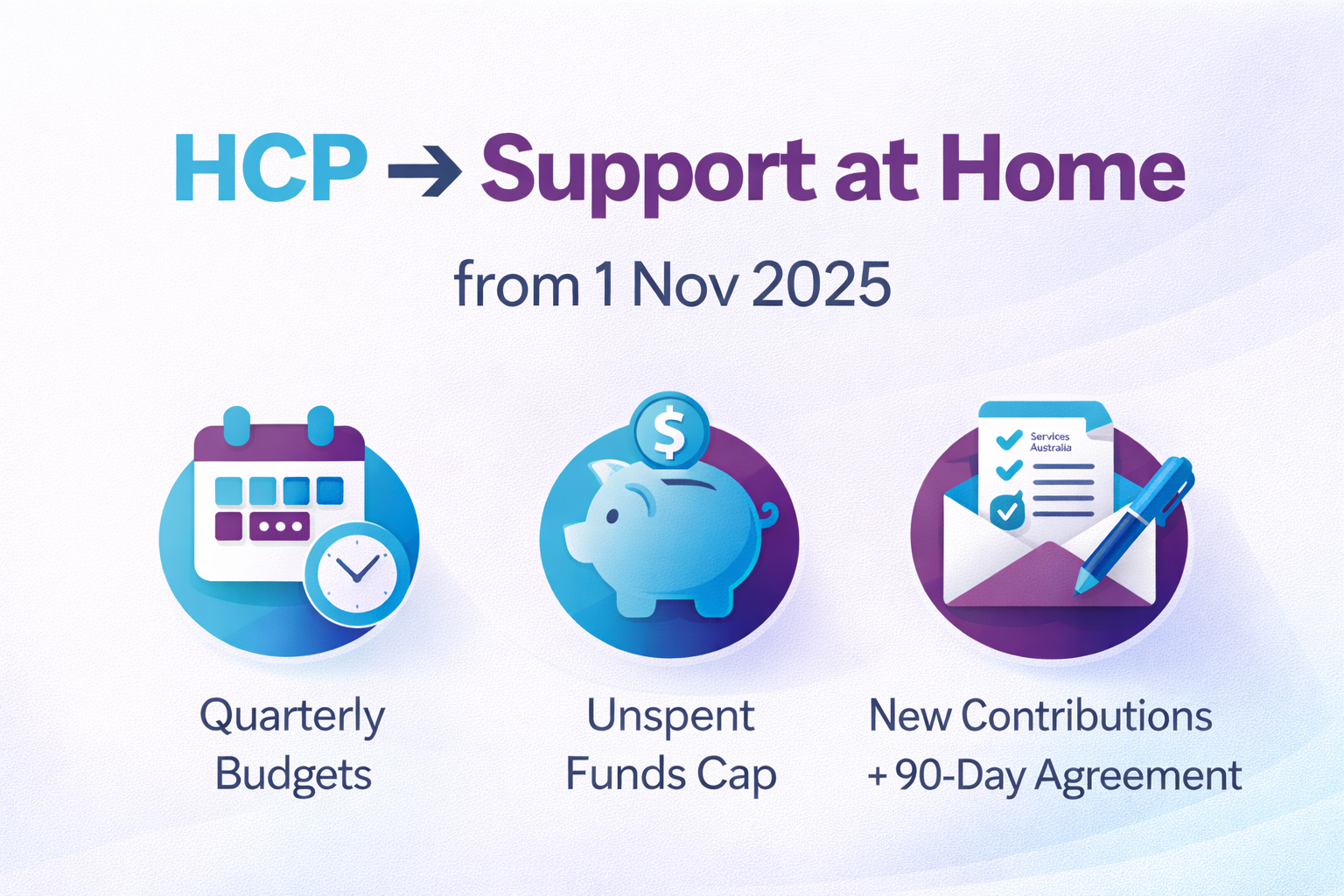
Support at Home program transition for Existing Home Care Package clients
Table of Contents
ToggleSupport at Home Program Transition: What Existing Home Care Package Clients Need to Know
Last updated: 13 February 2026. This article is general information only and doesn’t consider your objectives, financial situation or needs. Aged care rules and guidance can change. For the latest official updates, check My Aged Care and the Department of Health and Aged Care – Support at Home.
If you’re an existing Home Care Package client, the Support at Home program transition can feel like yet another set of letters, new terminology, and “agreement deadlines” arriving at the same time as care needs are changing. Families usually ask the same practical questions:
- Will Mum or Dad’s services change?
- Will fees change?
- What do we need to do so services don’t stop?
This guide explains what changed when Home Care Packages ended and clients moved into Support at Home, what “grandfathered” and “no worse off” means, how the new quarterly budgets work (including what can carry over), and the key steps to take when you receive a Services Australia contribution letter.
If you want help modelling contributions, choosing a provider confidently, or building a quarterly “use it wisely” plan, see Aged Care Financial Planning Services or reach out via Contact Us.
Key takeaways
- Support at Home replaces Home Care Packages and changes how budgets, pricing and client payments are presented.
- Budgets are released quarterly, so planning services by quarter matters more than it used to.
- Unspent funds rules are tighter going forward — treat it as “plan it or lose it”, even if you have carried-over HCP funds.
- “Fees” are now framed as contributions and can depend on pension status and an income/assets assessment.
- Many existing clients are protected by the “no worse off” principle (but you still need to confirm your status when letters arrive).
- Service agreements have a deadline: if you transitioned and haven’t yet signed, the current rules link timing to your confirmed contribution rate from Services Australia.
- Provider pricing can feel higher because more overhead is built into unit prices—this makes comparing providers and building a quarterly budget more important than ever.
Table of contents
- What is the Support at Home program?
- What changes for existing Home Care Package clients?
- Quarterly budgets: how funding is now released
- Unspent funds: what carries over and what you can lose
- Fees replaced by “contributions” (and why pension status matters)
- Grandfathered clients and the “no worse off” principle
- Services Australia letters and service agreement deadlines
- Reporting changes in circumstances within 28 days
- Pricing changes: lower admin slice, higher unit prices?
- Action checklist for families
- Common mistakes we see
- FAQs
- How we help
- Official links and tools
What is the Support at Home program?
The Support at Home program is Australia’s in-home aged care program that replaced the Home Care Packages (HCP) Program (and also replaced the Short-Term Restorative Care Programme). Official overviews are available at:
For most people, the goal is the same: coordinated services to support safe living at home. What changes is how budgets are released, how out-of-pocket costs are described and calculated, and how providers present pricing and monthly statements.
Important context for families: Support at Home is designed to be more transparent and unit-priced. That’s good in theory, but it also means families need to pay more attention to service agreements and budgets—especially during the transition year.
What changes for existing Home Care Package clients?
If your parent was receiving a Home Care Package immediately before the transition, the main “money and administration” changes usually fall into five buckets:
- Funding is now released quarterly (rather than feeling like one continuous pool).
- Carry-over rules are tighter for new quarterly budgets (even if older unspent HCP funds remain available).
- “Fees” move to a contributions framework which can depend on pension status and an assessment.
- New service agreement timing and deadlines based on Services Australia confirmation.
- Pricing presentation changes (care management portion, unit pricing, overheads included in line items).
It helps to hold two ideas at once:
- The program structure is changing (budgets, agreements, how prices are shown).
- Your parent’s care needs are also changing (and the system doesn’t slow down while you learn the new rules).
If you’re juggling broader aged care decisions at the same time (for example, weighing a move to residential care later), this overview can help with the bigger cost picture: A guide to the costs of aged care.
Quarterly budgets: how funding is now released
Under Support at Home, funding for ongoing support is typically released in quarterly budgets. My Aged Care explains how budgets work and how to manage them here: Managing your Support at Home budget.
Why this matters: quarterly release means service planning needs to be more deliberate. Under the old Home Care Package mindset, many families “let it run” and looked at statements occasionally. Under quarterly budgets, you get better outcomes when you plan the quarter intentionally:
- What services are essential every week?
- What services are optional and can be adjusted?
- Are there likely spikes this quarter (falls risk, surgery recovery, caregiver burnout)?
Practical tip: Ask the provider for a written quarterly budget plan that matches your parent’s routine—then stress-test it. If a shower support is cancelled twice a week, where does that money go? What is the provider’s rule for rolling services forward? Clarity now reduces disputes later.
Unspent funds: what carries over and what you can lose
1) Unspent Home Care Package funds as at the transition
Many families built up unspent funds under the old Home Care Package system (sometimes intentionally). Under current guidance, unspent HCP funds can remain available for use under Support at Home, held separately from your quarterly budget. My Aged Care explains unspent package funds here: Unspent Home Care Package funds.
Practical implication: those legacy funds can be a valuable buffer for planned spikes—extra personal care after a fall, a short burst of transport, or extra domestic assistance while a family carer is unavailable. But you still want a plan, because pricing and administration rules are shifting.
2) Unspent quarterly Support at Home funds going forward
Support at Home introduces tighter carry-over rules for unspent quarterly budgets. The specifics can change over time, so treat any numbers as “current at time of writing” and confirm via My Aged Care and the Department’s current Support at Home resources.
What this means in plain English: you should avoid accidentally “under-using” a quarter. If your parent’s needs are stable but the plan is too conservative, you may end the quarter wishing you had used the budget more effectively (for example, extra allied health, extra support during a rough patch, or home safety improvements).
If you’re uncertain how home supports fit into longer-term plans (including future residential care decisions), it can be helpful to understand how means testing works overall: How aged care means testing works.
Fees replaced by “contributions” (and why pension status matters)
Under Home Care Packages, families often talked about “basic daily fees” and “income-tested care fees”. Under Support at Home, official guidance uses the language of participant contributions. Contributions can depend on:
- pension status (full pensioner, part pensioner, non-pensioner)
- income and assets assessment (where required)
- service type (some categories can have different contribution expectations)
The Department’s participant contributions fact sheet is a useful starting point: Support at Home program – participant contributions.
Why this matters: two clients with similar services can have very different out-of-pocket costs depending on assessment outcomes and whether they are protected by transitional arrangements. If your family’s income and assets picture is complex (companies, trusts, gifting history), it’s worth understanding the broader rules before you sign agreements. See: Trusts and aged care expenses.
Grandfathered clients and the “no worse off” principle
One of the biggest protections for existing clients is the “no worse off” principle. In short: certain clients who were already in the system by a key date are protected so they don’t pay more simply because the program changed. The Department’s participant contributions guidance explains this principle and how it applies: Support at Home program – participant contributions.
Why families still need to pay attention: protection doesn’t remove the need to check letters, confirm status, and sign the correct agreement. Many problems we see are not about eligibility—they’re about administration and missed deadlines.
Practical tip: When the Services Australia letter arrives, file it (PDF + a paper copy), then compare it to your provider’s draft agreement. If anything looks inconsistent—pause, ask questions, and get clarification in writing.
Services Australia letters and service agreement deadlines
One of the most important transition steps is signing (or updating) the Support at Home service agreement with your provider.
The Department has published specific guidance that, for participants who transitioned from Home Care Packages and haven’t yet entered into a Support at Home agreement, there is a timeframe linked to the date they receive a confirmed contribution rate from Services Australia: Service agreements for Support at Home. The Aged Care Quality and Safety Commission has also reminded providers not to pressure older people to finalise agreements earlier than required: Support at Home pricing information and service agreements.
What families should do:
- As soon as the Services Australia letter arrives, note the date received.
- Ask the provider for the service agreement and the pricing schedule in writing.
- Check the agreement includes: services, unit prices, care management, travel rules, cancellation rules, minimum shift rules, statements and reporting.
- If someone is signing for your parent, confirm legal authority is accepted by the provider. This is essential reading: Power of attorney and aged care: what you need to know.
Reporting changes in circumstances within 28 days
Even where transitional protections apply, families should keep details current. Services Australia explains that changes in circumstances can affect aged care costs and should be reported within required timeframes: Changes to your circumstances and aged care costs.
What counts as a “change”? It can include income changes, asset changes, relationship changes, changes to living arrangements, or anything that could affect contribution assessments. When in doubt, report and keep a record of the report (date, reference number, and what was provided).
Pricing changes: lower admin slice, but higher unit prices?
Care management is now more clearly defined
Support at Home aims to make care management easier to understand by defining it more clearly as part of the budget. My Aged Care explains budget management and care management within Support at Home here: Managing your Support at Home budget.
What families often notice: the admin line items may look “cleaner”, but service unit prices can feel higher because more overhead is baked into each unit price rather than itemised separately.
Providers set prices initially; price caps commence later
In the early phase, providers continue to set their own prices, with price caps introduced from 1 July 2026. My Aged Care summarises these pricing changes here: Support at Home pricing changes. The Department’s fact sheet also discusses the staged approach and the commencement of price caps: Changes to Support at Home pricing arrangements (fact sheet).
What families should do right now:
- Ask for the provider’s updated pricing schedule (attached to the agreement).
- Compare unit prices for the highest-use items (personal care hours, domestic assistance, transport, allied health where relevant).
- Ask how travel, minimum shifts and cancellations are charged.
- Request a simple quarterly forecast: “If we keep the same services, what happens to the quarterly budget by week 6?”
Action checklist for families
Use this checklist to reduce disruption and avoid unpleasant surprises.
Step 1: Confirm the program status and get the right documents
- Start with My Aged Care – Support at Home if you need an overview.
- Locate any letter from Services Australia that confirms contribution settings and file it safely.
- If a family member is acting as representative, confirm authority documents are current and accepted: Power of attorney and aged care.
Step 2: Review the provider agreement properly (not rushed)
- Ask for the service agreement and the full pricing schedule in writing.
- Check services, unit prices, travel rules, minimum shift rules, cancellation fees, and how often statements are provided.
- Ask how unspent budget is handled and what the process is if you want to change services mid-quarter.
Step 3: Build a quarterly budget plan (“use it wisely”)
- List essential weekly services and “nice to have” services.
- Plan for spikes (illness, falls risk, carer fatigue).
- Use legacy unspent funds strategically, not accidentally.
Step 4: Keep reporting up to date
- Report changes in circumstances on time and keep a record: Services Australia – changes to circumstances and aged care costs.
Step 5: Link home support planning with the bigger aged care picture
- If residential care may be on the horizon, learn the cost structure early: A guide to the costs of aged care.
- If your family’s financial position is complex, understand how means testing works: Aged care financial means test.
Need help interpreting the letter or the agreement? If you’ve received a Services Australia contribution letter and you’re unsure what it means (or you’re worried about the agreement deadline), start with Contact Us. We’ll help you translate the paperwork into a practical plan.
Common mistakes we see
- Treating the service agreement as “just paperwork”. It’s where pricing, rules and responsibilities are set.
- Not asking for the pricing schedule. Families agree to services without seeing the real unit prices and add-ons.
- Under-using quarterly budgets accidentally. Without a quarterly plan, families can miss opportunities to use supports effectively.
- Assuming grandfathering means “ignore everything”. Protections help, but deadlines and documentation still matter.
- Not clarifying authority early. Delays and disputes occur when providers won’t accept who is signing. Read Power of attorney and aged care.
- Not reporting changes on time. Late reporting can create backdated adjustments and confusion.
FAQs
1) What is the Support at Home program?
The Support at Home program is Australia’s in-home aged care program that replaced Home Care Packages. It changes how budgets are released, how pricing is presented, and how participant payments are described. Start with My Aged Care – Support at Home.
2) Will existing Home Care Package services change immediately?
Often services continue, but the agreement, budget structure and pricing presentation may change. The biggest practical risk is not the service itself—it’s delays or confusion around agreements and budgeting that lead to disruption.
3) What does “grandfathered” mean under Support at Home?
Some existing clients are protected by the “no worse off” principle so they don’t pay more simply because the program changed. Confirm your status using official guidance and any Services Australia correspondence. See the Department’s contributions fact sheet: Support at Home participant contributions.
4) Do we need to sign a new service agreement?
Many transitioning clients do. The timing and obligations are set out in official guidance, and the agreement is where pricing and service rules are made clear. See Service agreements for Support at Home and My Aged Care – agreeing to Support at Home services.
5) Why do unit prices look higher than before?
In the early phase, providers continue to set their own prices and more overhead may be included within unit pricing rather than itemised separately. Price caps are being introduced later (check official updates). See Support at Home pricing changes.
6) What should we do if we think the contribution setting is wrong?
First, confirm what assessment information Services Australia used and whether details are current. Keep everything in writing and request clarification. If you need help understanding the broader assessment concepts, read how aged care means testing works.
7) Who can sign the service agreement if Mum or Dad can’t?
This depends on legal authority and the provider’s requirements. Many families use an Enduring Power of Attorney or other formal authority. See Power of attorney and aged care: what you need to know.
8) How do we make sure the quarterly budget actually matches needs?
Ask the provider for a written quarterly plan that lists services, frequency, unit prices and totals. Then review it against real life: falls risk, medication changes, caregiver fatigue, and hospital admissions. Adjust early in the quarter, not at week 11.
How we help
Support at Home sounds simple until you’re dealing with real-world variables: uneven care needs, changing cognition, informal carers burning out, provider price models, and the psychology of quarterly budgeting. We help families turn “letters and confusion” into a plan you can act on.
Depending on what you need, we can help you:
- confirm transitional status and interpret Services Australia outcomes
- model contributions and build a quarterly support plan that protects continuity of care
- stress-test provider pricing so you understand what the budget will realistically cover
- coordinate aged care decisions with retirement cashflow and family objectives
Start here: Aged Care Financial Planning Services. For fee transparency, see Aged Care Financial Advice Costs. To speak with us, use Contact Us.
General advice only disclaimer
This information is general in nature and doesn’t consider your objectives, financial situation or needs. Aged care rules can change—confirm details with My Aged Care, Services Australia and the Department of Health and Aged Care or seek personal advice.
Official links and tools
- My Aged Care – Support at Home program
- My Aged Care – Managing your Support at Home budget
- My Aged Care – Agreeing to Support at Home services
- Department of Health and Aged Care – Support at Home
- Department – Support at Home participant contributions (fact sheet)
- Department – Service agreements for Support at Home
- Services Australia – Changes to circumstances and aged care costs
- My Aged Care – Support at Home pricing changes