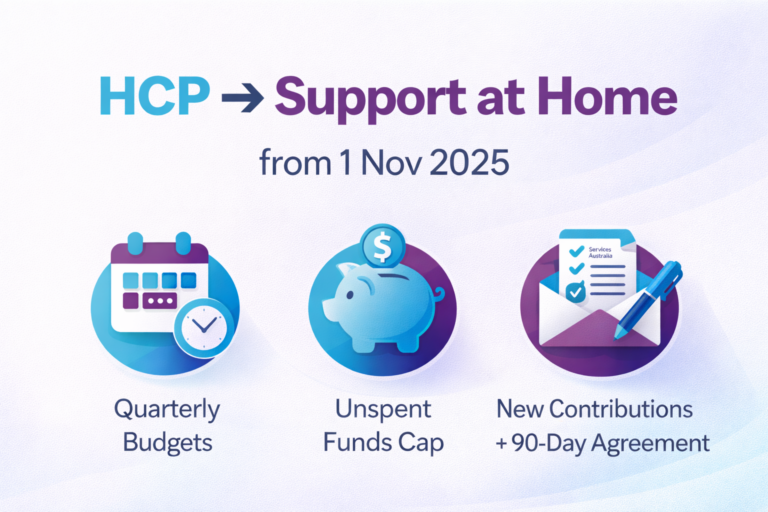

Planning Aged Care Finances for Ageing in Place
Table of Contents
ToggleAgeing in place is no longer a niche preference—it’s the mainstream aspiration for older Australians who want to retain autonomy, community connection and routine. The challenge isn’t just finding support; it’s sequencing and financing that support so care remains sustainable and flexible as needs evolve. Sound financial structuring is the difference between a dignified decade at home and a scramble when care intensity steps up.
Planning Aged Care Finances for Ageing in Place
What “ageing in place” really means
Ageing in place means continuing to live in your own home (or a home-like setting) with the right mix of formal home care, informal support, and clinical input. It’s a continuum—not a set-and-forget plan. The financial architecture must anticipate three phases:
- Foundational phase: low-level help (cleaning, shopping, transport, safety modifications).
- Transitional phase: increased personal care, allied health, respite, medication support.
- Complex phase: higher-frequency visits, case management, night support, and potential palliative care at home.
Each phase has distinct cost profiles, funding sources and decision points.
Why more Australians are choosing home over facility
- Control and familiarity: Home routines reduce disorientation and anxiety.
- Clinical feasibility: Hospital-in-the-home, telehealth, remote monitoring and mobile allied health have expanded at-home options.
- Policy settings: Government subsidies encourage community-based supports to delay or avoid residential care.
- Family dynamics: Adult children often prefer coordinated home supports over a rushed move into residential care.
The cashflow reality: mapping typical costs
A realistic home-care budget accounts for:
- Care hours: personal care, domestic assistance, meal prep, respite, social support.
- Clinical/allied health: nursing, physio, OT, podiatry, continence support.
- Care management & package administration: if using a Home Care Package (HCP) provider.
- Home modifications & equipment: rails, ramps, bathroom refits, lift chairs, mobility aids, sensor tech.
- Transport & community access: taxis/community transport when driving stops.
- Health out-of-pockets: GP gap fees, specialists, pharmaceuticals not on concessional arrangements.
- Property costs: rates, insurance, utilities, gardening, repairs—these don’t pause with frailty.
- Contingency for step-ups: night care, post-hospital bursts, increased frequency of visits.
Your plan should model baseline, moderate and high-care scenarios and show how each is funded without eroding capital too quickly.
Government supports at home: getting the framework right
My Aged Care gateway
Assessment (ACAT/ACAS) opens eligibility for Commonwealth Home Support Programme (CHSP) for entry-level services and Home Care Packages (HCP) for ongoing, coordinated support. Waiting times can apply, so interim CHSP or private-pay services often bridge the gap.
Home Care Packages (HCP)
HCP funding is tiered (Levels 1–4) to match care needs. Funds are held in an individual budget managed by an approved provider. You can choose self-management (lower fees, more admin on you) or full case management (higher fees, less admin). Income-tested fees may apply depending on assessable income. The package can fund care, equipment, modifications, nursing, allied health, and respite—subject to program rules.
Commonwealth Home Support Programme (CHSP)
Entry-level services with client contributions. CHSP is useful early or as a supplement while you wait for an HCP. It’s generally “menu-based” rather than fully case-managed.
Short-term programs
- Transition Care after hospital discharge (short-term reablement).
- Flexible/rapid response services via local health networks.
- Carer support through respite and counselling.
Planning tip: Secure an assessment early—eligibility in the system gives options even if you choose to delay services.
Fees, contributions and what to watch
- HCP provider fees: administration and care management fees vary considerably and can materially dilute your package value. Scrutinise them.
- Income-tested care fees (HCP): if your assessable income exceeds thresholds, you may be asked to contribute up to capped amounts. Means are assessed by Services Australia; ensure your financial records are accurate.
- CHSP contributions: modest, means-sensitive contributions per service.
- Private-pay gap: even with subsidies, higher-intensity rosters often need topping up with private hours.
- Equipment and home mods: some items are claimable through your package; others may require private payment or state schemes.
Planning tip: Avoid relying on “headline package level” alone. The net usable budget after fees is what matters.
Income architecture for sustainable cashflow
A robust at-home plan usually blends:
- Age Pension and supplements: set-and-forget base income; maximise entitlements by structuring assets efficiently.
- Account-based pensions (super): flexible, tax-effective drawdowns; calibrate to care intensity and market risk.
- Term deposits/cash buckets: liquidity for short bursts (post-hospital care, urgent repairs).
- Investment income: franked dividends, bond coupons or managed funds—balanced against volatility tolerance.
- Home equity strategies: reverse mortgage or the Home Equity Access Scheme (HEAS) to convert part of your home’s value into income.
- Family contributions: formalise to avoid disputes or Centrelink misunderstandings.
Cashflow design rule: Align predictable costs to predictable income (pension, annuity, minimum super drawdown) and fund variable or high-cost bursts from a dedicated “care buffer”.
Using the family home wisely (without tripping legal or Centrelink rules)
Reverse mortgage
A regulated loan secured against the home, with optional drawdown styles (lump sum, line of credit, regular income). Interest compounds; repayment typically occurs when the home is sold or the borrower moves out permanently. Consider:
- Negative equity guarantees and responsible lending checks.
- Rate sensitivity and longevity risk (living longer than expected).
- Estate impacts and the fairness conversation with adult children.
Home Equity Access Scheme (HEAS)
A government-administered pension loan that advances fortnightly payments (and in some cases lump sums) secured against real property. It offers flexibility and safeguards distinct from commercial loans. Useful for topping up income to fund private care hours.
Granny flat interests (GFI)
Transferring assets to a child in exchange for a life interest/occupancy right can be an effective housing solution, but it’s technical. The arrangement should be documented, ideally registered on title where possible, and carefully structured to manage deprivation rules, elder abuse risk, and family law exposure.
Planning tip: Always model “what if care needs spike?” before locking in equity.
Gifting, deprivation and family support—avoiding traps
Under social security rules, gifting above allowable limits is counted as a “deprived asset” for a period and can reduce Age Pension or increase income-tested care fees. Common pitfalls:
- Transferring money to children to “help out” without understanding the look-back rules.
- Paying for renovations to someone else’s property without a formal GFI.
- Forgiving loans informally—Centrelink may still treat them as assets unless properly documented and unrecoverable.
Best practice: Keep a paper trail. Use written loan agreements or family constitutions for larger transfers. Seek advice before moving funds.
Tax, super and portfolio strategy for at-home care
- Tax-free super income (60+): Often the core income stream, but review minimum drawdowns against sequence-of-returns risk.
- Rebalancing & liquidity: Tilt portfolios toward reliable income and a 2-3 year “care reserve” in cash/TDs to ride out market dips without cutting care.
- CGT planning: Funding a big home modification by selling assets can trigger CGT; consider parcel selection, discount eligibility, and timing.
- Annuities as a stabiliser: Lifetime or long-term annuities can underpin essential care costs and may favourably interact with means tests.
- Health-related deductions: Some medical expenses or equipment may have concessions/rebates; keep receipts and check eligibility annually.
Cost-reducing tactics that don’t compromise care
- Right-size the roster: Combine short, well-timed visits (e.g., morning personal care plus meal prep every second day) rather than daily long blocks.
- Leverage reablement: Short bursts of OT/physio can reduce long-term manual handling needs and hours.
- Tech substitution: Medication dispensers, falls sensors, and video check-ins can reduce overnight supervision while maintaining safety.
- Volunteer and community layers: Men’s Sheds, social groups, community transport and local council services stretch budgets and fight isolation.
- Co-ordination minimises duplication: One lead provider (or a savvy self-management model) prevents multiple parties charging overlapping fees.
Carers and the household economy
Family carers often anchor the plan. Consider:
- Carer Payment/Carer Allowance: Check eligibility; modest income support can fund respite.
- Respite budgeting: Plan routine respite (day centres, in-home relief, short-stay) before burnout.
- Employment flexibility: Salary packaging, carer’s leave, or adjusted hours—small changes can be decisive for sustainability.
- Boundaries and safety: Clear task lists and escalation plans prevent overreach and reduce injury risk for carers.
Housing, safety and capital works
Prioritise modifications that pay for themselves by reducing future care intensity:
- Falls prevention: slip-resistant flooring, lighting, rails, threshold ramps.
- Bathroom redesign: walk-in showers, handheld showerheads, non-slip finishes, room to manoeuvre mobility aids.
- Kitchen pragmatics: drawer storage, bench height, induction cooktops with auto-off.
- Access solutions: platform steps, stairlifts, door widening.
- Climate resilience: reliable heating/cooling to avoid hospitalisations in heatwaves/cold snaps.
Bundle works to minimise call-out fees; seek OT input and use package funds where eligible.
Legal scaffolding: decision-making and safeguarding
- Enduring Power of Attorney (financial) and Enduring Guardianship/Appointment of Decision-Maker (health & lifestyle): put them in place early; choose people with financial prudence and availability.
- Advance care directive: capture preferences about life-sustaining treatment and goals of care.
- Service agreements: insist on transparent HCP agreements—fees, exit fees (if any), notice periods, brokerage policies and complaints process.
- Elder abuse protections: separate bank accounts, view-only access for helpers, two-to-sign arrangements for major transactions, and independent legal advice for family agreements.
- Estate planning alignment: Wills, beneficiary nominations (binding where appropriate), super death benefit strategy, and clear records of loans/gifts to children.
Centrelink and means testing—key touchpoints
- Age Pension optimisation: Structure assets (including financial investments and annuities) to support entitlements without undermining liquidity.
- Deeming of financial assets: Impacts pension and may flow into income-tested care fees. Review annually or after major changes.
- Home status: The principal residence is exempt for Age Pension assets test, but arrangements like granny flats or renting rooms can have implications—seek advice before changing use.
- Reporting obligations: Notify changes in circumstances promptly—new investments, gifts, inheritances, home equity draws, or changes in living arrangements.
Private health, hospital, and the “step-up” plan
- Elective procedures: time them around care rosters and respite availability.
- Post-acute surges: budget for 2–6 weeks of higher-intensity support after hospital stays; this is where cash buffers shine.
- Palliative care at home: feasible with the right clinical wraparound; clarify provider capacity and after-hours escalation before it’s urgent.
- Trigger points for review: two or more falls in a quarter, significant weight loss, carer illness, or night wandering—all signal a financial and care plan review.
Self-management vs provider-managed packages
Self-management can reduce fees and stretch funds, but requires time, organisation and confidence with invoices and rostering. Provider-managed offers coordination and clinical governance but watch fee creep. A hybrid model—provider case management with some self-sourced services—often hits the sweet spot.
Checklist when comparing providers:
- Net dollars to spend (after all fees).
- Hourly rates for common services.
- After-hours availability.
- Flexibility to add your preferred workers.
- Exit/transfer terms.
- Brokered service mark-ups.
Scenario planning: stress-testing your numbers
Model three scenarios for the next 5–10 years:
- Steady state: low-level support, modest out-of-pockets.
- Moderate escalation: daily personal care, weekly nursing/allied health, regular respite.
- High care at home: multiple daily visits, some night care, equipment rental, frequent clinical input.
For each, map:
- Total monthly cost, split by subsidised vs private-pay.
- Funding sources (pension, super drawdown, HEAS/reverse mortgage, family).
- Asset trajectory (how quickly capital shrinks under each scenario).
- Decision triggers (when to reassess housing or increase equity release).
Common pitfalls and how to sidestep them
- Waiting to apply: Delays in assessment can leave you paying full private rates during crises. Apply early.
- Over-spending in year one: Pace equipment purchases—trial before buy where possible.
- Ignoring admin fees: A seemingly small percentage can equal dozens of foregone care hours each month.
- No cash buffer: Market dips shouldn’t force you to cut essential care.
- Ad-hoc family payments: Generosity can unintentionally reduce entitlements; formalise everything.
A practical 12-point action plan
- Book a My Aged Care assessment (HCP/CHSP eligibility).
- Draft or update enduring powers and advance care directive.
- Build a 6–12 month “care buffer” in cash/TDs.
- Review super drawdowns and investment risk to support care phases.
- Benchmark three HCP providers (compare net package dollars and rosters).
- Commission an OT home safety assessment.
- Prioritise low-cost, high-impact modifications first (falls prevention).
- Cost a moderate and high-care scenario; identify funding sources for each.
- Assess HEAS vs reverse mortgage, with estate and Centrelink modelling.
- Put family support in writing (tasks, respite, boundaries).
- Create a hospital-to-home surge plan (pre-approved hours, transport, meals).
- Schedule six-monthly reviews—or sooner after any trigger event.
When home might not be the best answer—having a Plan B
Sometimes, the economics or safety profile tips toward supported accommodation or residential care. Keeping a provisional Plan B avoids hasty decisions. Maintain a shortlist of preferred facilities or retirement living options, understand costs and RAD/DAP mechanics, and keep documents and financial summaries ready if circumstances change.
How a specialist aged care financial adviser adds value
- Cashflow engineering: turning fragmented income sources into a dependable care budget.
- Means-testing optimisation: structuring assets for Age Pension and minimising income-tested care fees within the rules.
- Equity release modelling: comparing HEAS, reverse mortgage and family solutions with clear estate trade-offs.
- Provider due diligence: translating fee tables into usable hours and outcomes.
- Documentation and safeguards: aligning legal documents, family agreements and service contracts.
- Review discipline: scheduled recalibration as needs evolve.
Final word
Ageing in place succeeds when finances, care and housing are choreographed deliberately. The right plan preserves autonomy, reduces family stress and keeps options open—even when needs escalate. If you’d like a tailored, numbers-driven plan that stress-tests your care options and protects your entitlements, book a confidential consultation with an accredited aged care financial adviser.