MPIR rate 1 April 2026 Update & age pension changes
Table of Contents
ToggleMPIR Rate 1 April 2026: What Families Need to Know
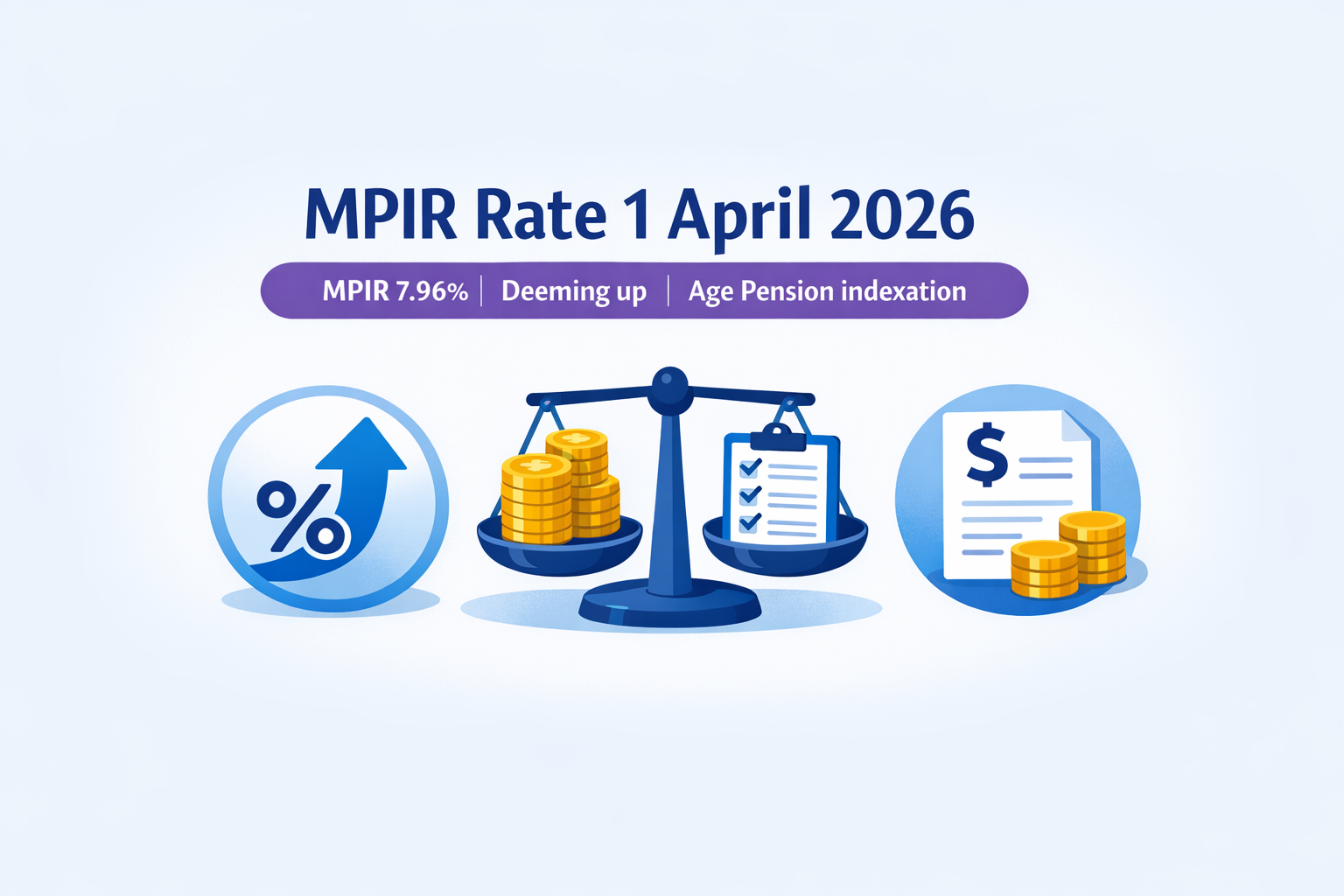
If you are helping a parent move into residential aged care in 2026, three money settings now matter at once. The residential aged care MPIR rises to 7.96% from 1 April 2026, while the deeming rates increased from 20 March 2026 to 1.25% and 3.25%, and the March 2026 Age Pension indexation confirmed higher pension rates and updated means-testing limits.
For some families, that means a higher DAP on new entries, a better Age Pension headline rate, and at the same time a possible pension reduction if the income test and deeming apply.
If you want the background first, our guide to the MPIR and interest rates in aged care explains why this quarterly rate matters, and our overview of the aged care financial means test shows how assessable income and assets can flow through to care decisions.
Key takeaways
- The MPIR is 7.96% p.a. for the 1 April to 30 June 2026 quarter.
- A higher MPIR mainly affects new DAP calculations and other accommodation payment calculations that use the current quarter’s rate.
- Deeming rates increased on 20 March 2026 to 1.25% and 3.25%.
- The maximum Age Pension from 20 March 2026 is $1,200.90 per fortnight for singles and $905.20 each for couples.
- Some part-pension clients may see less benefit from indexation because higher deeming can reduce pension under the income test.
- Families should review RAD vs DAP, pension cash flow, and whether one partner remains at home before signing accommodation documents.
- These figures are current at time of writing and should be confirmed with Services Australia, DSS and the Department of Health, Disability and Ageing.
Table of contents
- What changed in March and April 2026
- The MPIR update from 1 April 2026
- Why the MPIR matters in aged care
- Does the new MPIR affect existing residents?
- Deeming rates rose on 20 March 2026
- Why deeming matters for aged care families
- March 2026 Age Pension rates
- Age Pension eligibility and thresholds
- Worked example: how these changes can interact
- What if only one member of a couple is eligible?
- Payment frequency, advances and rent assistance
- Transitional Age Pension rates
- Common mistakes to avoid
- Decision checklist
- FAQs
- What to do next
What changed in March and April 2026
Here is the short version.
| Change | Date | New setting | Why it matters |
|---|---|---|---|
| MPIR | 1 Apr 2026 | 7.96% p.a. | Affects DAP and other accommodation calculations for new or relevant arrangements |
| Lower deeming rate | 20 Mar 2026 | 1.25% | Can increase assessable income for income-tested pensioners |
| Upper deeming rate | 20 Mar 2026 | 3.25% | Same issue for higher financial asset balances |
| Maximum Age Pension (single) | 20 Mar 2026 | $1,200.90 pf | Better cash flow for full-rate pensioners |
| Maximum Age Pension (couple, each) | 20 Mar 2026 | $905.20 pf | Better cash flow for couples on the full rate |
The MPIR figure is published by the Department of Health, Disability and Ageing, while the March 2026 pension rates and means-testing limits were published by DSS and Services Australia.
The MPIR update from 1 April 2026
From 1 April 2026 to 30 June 2026, the Maximum Permissible Interest Rate (MPIR) for residential aged care is 7.96% per annum. This is a modest increase from the previous quarter rather than a major jump.
In plain English, the MPIR is one of the key rates used to calculate accommodation costs in residential aged care. It is used to calculate daily accommodation payments (DAPs) and related accommodation payment amounts.
That is why this change matters most for:
- families about to sign a room agreement
- residents entering care in the new quarter
- situations where a payment structure is still being finalised.
Before choosing a payment method, read our plain-English guide to how RADs and DAPs work.
Why the MPIR matters in aged care
The MPIR matters because it affects the cost of paying by daily accommodation payment instead of, or in combination with, a refundable accommodation deposit (RAD).
A simple way to think about it is this:
DAP = unpaid accommodation lump sum × MPIR ÷ 365
That means when the MPIR goes up, the daily cost of leaving some of the room price unpaid also goes up. The effect will depend on the room price and how much RAD is paid upfront.
This is also why the quarterly MPIR change can influence the RAD vs DAP decision. A small rate change may not sound dramatic, but over a full year it can still mean real cash flow pressure for a family already juggling care fees, household costs and Centrelink changes.
If you want a side-by-side comparison, our article on RAD vs DAP and which may be more cost-effective takes that further.
Does the new MPIR affect existing residents?
Usually, not automatically. The key issue is the date the room price was agreed. In most cases, the new quarter’s MPIR mainly matters for new entrants and anyone still deciding how to structure their accommodation payment.
That is one reason families should slow down before signing. Rushing to accept a room, sell assets or move money between accounts can create a much bigger long-term cost than the headline quarterly change itself.
Deeming rates rose on 20 March 2026
The other major March change is outside aged care legislation but still highly relevant to aged care families: deeming rates rose from 20 March 2026.
The new rates are:
- Lower deeming rate: 1.25%
- Upper deeming rate: 3.25%
The increases were made following recommendations by the Australian Government Actuary.
Deeming is the rule set Centrelink uses to estimate income from financial assets. That deemed income is then used under the income test to work out payment rates.
Why deeming matters for aged care families
This is the part many families miss.
When a parent moves into care, attention naturally goes to the RAD, the family home, and the ongoing aged care bill. But if that parent is on a part Age Pension and their entitlement is determined by the income test, higher deeming can reduce pension even if nothing else in their portfolio has changed.
That does not mean every client will be worse off. Full-rate pensioners may still benefit from the March increase without seeing a direct pension reduction from deeming. Some part-pensioners may still be better off overall. Others may find the higher deeming rate offsets part, or all, of the pension uplift.
The real answer depends on whether the income test or assets test is the binding test, and on the mix of cash, term deposits, shares and superannuation left outside the family home.
That is also why broader strategy matters. If one spouse remains at home, or the house is being kept rather than sold, the interaction can become more complex. This guide on moving into aged care with a partner still at home is often essential reading.
A quick reality check: if your family is making aged care decisions around the same time as a Centrelink change, it is worth modelling the whole picture before acting. The goal is not to predict a perfect outcome. It is to make the trade-offs clearer before expensive decisions are locked in.
March 2026 Age Pension rates
The March 2026 indexation confirmed higher Age Pension rates from 20 March 2026.
| Age Pension rate from 20 Mar 2026 | Per fortnight | Approx. per year |
|---|---|---|
| Single | $1,200.90 | $31,223 |
| Couple (each) | $905.20 | $23,535 |
| Couple (combined) | $1,810.40 | $47,070 |
These figures include the pension and energy supplements where applicable. Annual figures are approximate.
The next scheduled social security indexation point is 20 September 2026.
Age Pension eligibility and thresholds
To qualify for the Age Pension, you generally need to be 67 or older, meet the residency rules, and satisfy both the assets test and the income test.
Current full-pension asset thresholds
Current at time of writing.
| Situation | Homeowner | Non-homeowner |
|---|---|---|
| Single | $321,500 | $579,500 |
| Couple (combined) | $481,500 | $739,500 |
Current part-pension asset cut-off points
Current at time of writing.
| Situation | Homeowner | Non-homeowner |
|---|---|---|
| Single | $722,000 | $980,000 |
| Couple (combined) | $1,085,000 | $1,343,000 |
Current income-test settings
Current at time of writing.
| Situation | Free area | Cut-off point |
|---|---|---|
| Single | $218 pf | $2,619.80 pf |
| Couple (combined) | $380 pf | $4,000.80 pf |
If a person is still doing some paid work, the Work Bonus can also help reduce the amount of employment income counted under the income test.
Worked example: how these changes can interact
Assume a single resident enters aged care on 10 April 2026 and agrees to a room price of $600,000. They choose to pay a $300,000 RAD and leave the remaining $300,000 unpaid.
Using the new 7.96% MPIR, the DAP would be about $65.42 per day. Under the previous quarter’s 7.65% MPIR, the same unpaid amount would have produced a DAP of about $62.88 per day. That is roughly $930 a year more in DAP for the same unpaid balance.
Now add Centrelink. Say the same person holds $250,000 in financial assets and is income-test affected. Using the March 2026 deeming rates and threshold for singles, the deemed income rises by about $1,250 a year compared with the previous rates. Spread across a year, that is about $48.08 per fortnight of extra assessable income.
If the income test is the binding test, the pension could reduce by about $24.04 per fortnight under the single taper. That is enough to absorb most, or even all, of the headline $22.20 pension increase.
That is why families should not look at the Age Pension increase in isolation. The better question is: what happens to total cash flow once the new DAP, the new deeming rates and any care fees are all considered together?
What if only one member of a couple is eligible?
Where only one member of a couple qualifies for Age Pension, the household is still assessed using couple-based means testing rules, not single thresholds.
In practice, that means families should be careful about assuming the older partner will simply be paid as a single person. If one spouse is moving into care and the other remains at home, the couple assessment can materially change the numbers.
For the wider picture, see our guide to the family home when moving into care.
Payment frequency, advances and rent assistance
The Age Pension is generally paid fortnightly, although weekly payments may be available in some circumstances.
An advance payment may also be available after at least three months on Age Pension. The current advance ranges are:
- Single: $559.50 to $1,678.50
- Couple: $421.75 to $1,265.25
Rent Assistance may also be available in some situations.
| Living arrangement | Minimum fortnightly rent to qualify | Maximum fortnightly Rent Assistance |
|---|---|---|
| Single | $154.80 | $219.40 |
| Couple (combined) | $250.80 | $206.80 |
Transitional Age Pension rates
A smaller group of pensioners remain on transitional rates. The confirmed March 2026 resident transitional rates are shown below.
| Transitional rate from 20 Mar 2026 | Per fortnight |
|---|---|
| Single resident | $977.70 |
| Couple resident (each) | $788.80 |
| Single non-resident / absent > 6 weeks | $883.60 |
| Couple non-resident / absent > 6 weeks (each) | $738.40 |
If you are being paid a transitional rate, it is worth checking the exact Services Australia treatment before making any aged care payment decision, because transitional cases can behave differently from standard pension cases.
Common mistakes families make after an indexation change
- Assuming the April MPIR change means every existing DAP will rise immediately.
- Looking only at the higher Age Pension rate and missing the effect of higher deeming.
- Choosing RAD or DAP based on instinct rather than modelling cash flow.
- Selling the family home too quickly before understanding the pension and aged care consequences.
- Forgetting that a partner still at home can change the assessment materially.
- Treating a headline government increase as a reason to stop reviewing the strategy.
You can also compare the broader picture in our guide to the costs of aged care.
Step-by-step decision checklist
- Confirm the date the room price will be agreed, because that affects which MPIR applies.
- Ask the provider for the room price and model full RAD, full DAP and part RAD/part DAP options.
- Review how much of the parent’s assets are in financial assets subject to deeming.
- Check whether the pension is actually determined by the income test or the assets test.
- If one spouse stays at home, review the impact on couple-based thresholds and cash flow.
- Confirm current figures with Services Australia, DSS and the Department of Health, Disability and Ageing.
- Do not sign the accommodation paperwork until the cash flow, pension and estate implications are understood.
FAQs
What is the MPIR in aged care?
The MPIR is the Maximum Permissible Interest Rate used in residential aged care accommodation calculations, including DAPs. From 1 April to 30 June 2026, it is 7.96% per annum.
Does the April 2026 MPIR change affect existing DAPs?
Generally, no. In most cases, the key impact is on new or newly agreed arrangements rather than existing ones.
Will everyone receive the full Age Pension increase?
No. The maximum rates increased from 20 March 2026, but the actual amount someone receives still depends on eligibility and means testing.
Why can higher deeming reduce Age Pension?
Because deemed income from financial assets is counted under the pension income test. If deemed income rises and the income test is the binding test, the Age Pension may reduce even if the investments themselves have not changed.
What are the March 2026 Age Pension rates?
From 20 March 2026, the confirmed maximum resident normal rates are $1,200.90 per fortnight for singles and $905.20 each per fortnight for couples.
What happens if only one member of a couple is eligible for Age Pension?
Couple-based means testing rules still apply, so families should not assume the eligible person will automatically be assessed using single thresholds.
How often is the Age Pension paid?
Usually fortnightly, although weekly payments may be available for some people in certain circumstances.
Can Age Pensioners get an advance payment?
Yes, in many cases. You can generally apply after at least three months on Age Pension, subject to eligibility and repayment rules.
Can Age Pensioners also get Rent Assistance?
Sometimes. It depends on living arrangements, rent paid and other eligibility rules.
What to do next
The March and April 2026 changes are a good reminder that aged care decisions are rarely just about one number. A slightly higher MPIR can change DAP cash flow. A higher Age Pension rate can help. Higher deeming can take some of that help away. And once you add the family home, a spouse at home, or a partially paid RAD, the right answer is often less obvious than it first appears.
If your family is dealing with the MPIR rate 1 April 2026 update at the same time as the March deeming and pension changes, book an online consult with Aged Care Financial Advisers. We work remotely across Australia, gather the documents first, model the options clearly, and help families understand the likely trade-offs before they commit. The value is clarity, speed and avoiding costly mistakes, not promises about outcomes.
Related articles
- Understanding RAD and DAP in aged care
- Aged care financial means test explained
- Moving into aged care with a partner still at home
- The family home when moving into care
- A guide to the costs of aged care
General advice only
General advice only: This information is general in nature and doesn’t consider your objectives, financial situation or needs. Aged care and Centrelink rules can change—confirm details with Services Australia, DSS, My Aged Care or the Department of Health, Disability and Ageing before acting, or seek personal advice.
Link map
Internal links
MPIR and interest rates in aged care → https://agedcarefa.com/importance-of-the-mpir-for-low-means-and-high-means-residents/
aged care financial means test → https://agedcarefa.com/aged-care-financial-means-test/
how RADs and DAPs work → https://agedcarefa.com/understanding-rad-and-dap-in-aged-care/
RAD vs DAP and which may be more cost-effective → https://agedcarefa.com/rad-vs-dap-which-option-is-more-cost-effective/
moving into aged care with a partner still at home → https://agedcarefa.com/moving-into-aged-care-with-a-partner-still-at-home/
the family home when moving into care → https://agedcarefa.com/the-family-home-when-moving-into-care/
guide to the costs of aged care → https://agedcarefa.com/a-guide-to-the-costs-of-aged-care/
External links
Department of Health MPIR page → https://www.health.gov.au/resources/publications/base-interest-rate-bir-and-maximum-permissible-interest-rate-mpir-for-residential-aged-care?language=en
Services Australia deeming page → https://www.servicesaustralia.gov.au/deeming?context=22526
Services Australia Age Pension eligibility page → https://www.servicesaustralia.gov.au/who-can-get-age-pension?context=22526
DSS social security indexation page → https://www.dss.gov.au/income-support-payments/social-security-indexation